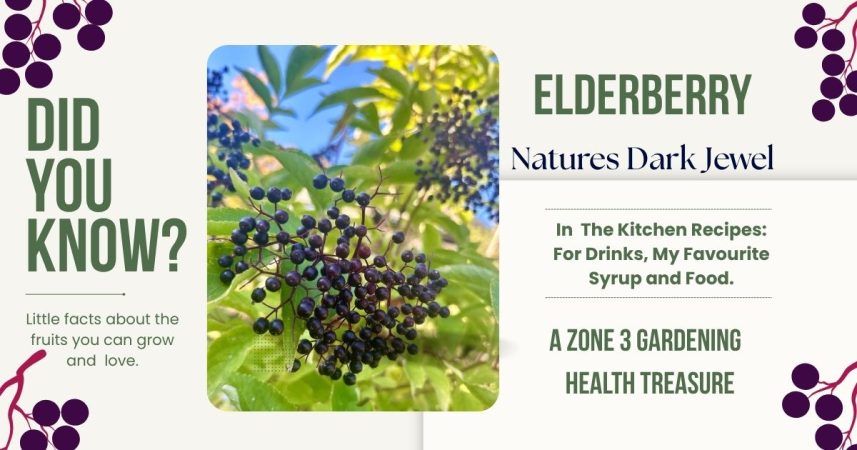
A Zone 3 Gardener’s Guide to Nature’s Dark Jewel
There’s something almost magical about watching an elderberry bush move through its seasons — from the frothy white umbels of early summer, to the weight of dark, glistening berries bending the branches by late August. Elderberry (Sambucus nigra, and its North American cousin Sambucus canadensis) has earned its reputation the old-fashioned way — through centuries of household and Indigenous use, long before “immune support” became a marketing phrase. Modern research is now catching up to some of that traditional wisdom.
Growing Elderberry in Zone 3
Elderberry is a wonderfully forgiving plant for prairie and northern gardens. It tolerates our cold winters well, adapts to a range of soil types, and — once established — asks for very little beyond a sunny to partly shaded spot and consistent moisture through its first couple of seasons.
I planted two elderberry bushes two years ago, and they’ve taught me a good gardening lesson: bush size doesn’t necessarily predict yield. One has grown to nearly double the size of the other, thanks to more mature, richer soil in that spot. But it’s definitely not about size — my smaller bush still put on a stunning show of flowers and went on to produce a full pail of beautiful dark berries. Patience, and good soil over time, pays off either way.
Which Parts of the Plant Are Used
- The berries (dark purple-black, fully ripe) are the most widely used part — cooked into syrups, jams, wines, and cordials
- The flowers (creamy white umbels) are used fresh or dried for teas, cordials, and elderflower syrup, and are prized in skincare for their gentle, soothing qualities
- The leaves, stems, bark, roots, and unripe berries are not for consumption — see the safety note below
| A Note on Safety First: Why Elderberry Must Be Cooked Raw and unripe elderberries, along with the leaves, stems, bark, and roots, contain cyanogenic glycosides — naturally occurring compounds that release small amounts of cyanide during digestion. Eating raw or undercooked berries can cause nausea, vomiting, and diarrhea, and larger quantities can cause more serious illness. The good news: heat destroys these compounds. Simmering ripe berries for roughly 20–30 minutes reliably neutralizes them, which is exactly why every traditional preparation — syrup, jam, wine, cordial — involves cooking. Never eat berries raw off the bush, and always discard the leaves and stems before cooking. |
Indigenous Traditional Use
Long before elderberry appeared in commercial syrups, it held — and still holds — an important place in Indigenous plant knowledge across North America. More than 60 Indigenous peoples, including the Iroquois, Cherokee, Paiute, Thompson/Ntlakyapamuk, and Kawaiisu, have documented traditional uses of elderberry for close to 50 different conditions, most commonly as a cold and fever remedy, a digestive and gastrointestinal aid, a pain reliever, and a treatment for skin complaints.
Beyond medicine, elder was — and is — a plant tended with care: berries dried and stored for winter use, flowers infused for fever-easing teas or steamed in sweat baths, and branches and wood shaped into arrow shafts, flutes, whistles, and dye for basketry. Ethnobotanist Sage LaPena, a Nomtipom and Tunai Wintu Medical Herbalist, has described elder as one of the most important and continuously used traditional medicines, with different parts of the plant — root, wood, berry, and flower — each harvested at its own specific time of year. That seasonal rhythm, tying the harvest of elderberry to the harvest of other foods, reflects a depth of ecological relationship worth honouring alongside the plant’s modern popularity.
What the Research Actually Shows
Elderberries are rich in anthocyanins — the deep purple-black antioxidant pigments responsible for both their color and much of their proposed benefit. Here is what current research points to, with an honest read on how strong that evidence is:
- Cold & flu symptom relief — small randomized trials, including a study of over 300 air travelers, found that elderberry supplementation was linked to fewer and shorter-lasting cold symptoms. Harvard Health’s review is measured: elderberry syrup or tea may help shorten duration and ease severity, but studies are small and mostly haven’t been compared against standard treatments.
- Antioxidant & anti-inflammatory activity — anthocyanins and related phenolic compounds show antioxidant and anti-inflammatory action in lab and animal studies, supporting elderberry’s traditional use for general wellness.
- Immune modulation — elderberry extracts stimulate immune cell activity in test-tube and animal research.
- Blood sugar & cholesterol support — preliminary studies suggest elderberry may help support healthy blood sugar and lipid levels, though robust human clinical trials are still needed.
- Skin health — antioxidant content may help reduce visible effects of UV-related skin damage.
Dosage Guidelines
There’s no single official dose, since products vary widely, but general ranges reported in clinical research and herbal references include:
- Elderberry syrup: roughly 15 mL (1 tablespoon), 2–4 times daily during acute illness, for adults
- Elderberry extract/lozenges: follow the manufacturer’s label, as concentration varies significantly by product
- Elderflower tea: 1–2 tsp dried flowers steeped in hot water, up to 3 times daily
- Duration: most traditional and clinical use is short-term — around 3–5 days for acute symptoms, not ongoing daily supplementation, unless guided by a practitioner
As always, start low and adjust to tolerance, and treat any commercial product’s label as the primary dosing guide.
Cautions and Who Should Avoid Elderberry
- Pregnancy and breastfeeding: evidence on safety is insufficient, so most clinicians recommend avoiding supplemental elderberry
- Autoimmune conditions (rheumatoid arthritis, lupus, multiple sclerosis): elderberry may stimulate immune activity and could theoretically worsen symptoms
- Immunosuppressant medications or organ transplant recipients: elderberry’s immune-stimulating action may counteract these drugs
- Diabetes medications: elderberry may lower blood sugar, raising the risk of hypoglycemia in combination
- Diuretics and laxatives: elderberry has mild diuretic and laxative properties of its own
- Young children: reserve for children over five, and only in properly prepared, cooked forms
Anyone on regular medication or managing a chronic condition should check with their healthcare provider before adding elderberry supplements to their routine.
In the Kitchen: Drink, Syrup & Food Recipes
Elderflower Cordial (Drink)
A fragrant, delicately floral syrup to dilute with sparkling water — made from the flowers, so no cooking-for-safety concerns here, just a quick infusion.
Ingredients
- 20–25 fresh elderflower heads, shaken gently to remove insects
- 1 litre water
- 750 g sugar
- 2 lemons, zested and juiced
- 1 tbsp citric acid (optional, for tang and shelf life)
Method
Bring water and sugar to a simmer until dissolved. Pour over the elderflowers, lemon zest, and juice in a large bowl. Cover and steep 24 hours. Strain through cheesecloth, bottle, and refrigerate. Dilute 1 part cordial to 4–6 parts water or sparkling water.
Classic Elderberry Syrup
The pantry staple — and the safest, most traditional way to use the berries.
Ingredients
- 3 cups fresh ripe elderberries (stems removed), or 1½ cups dried
- 3 cups water
- 1 cinnamon stick
- 1-inch piece fresh ginger, sliced
- 1 cup raw honey (added after cooling, off the heat)
Method
Simmer berries, water, cinnamon, and ginger for 30–45 minutes, until reduced by about half. Mash the berries gently, strain through a fine sieve or cheesecloth, and let the liquid cool to lukewarm before stirring in the honey. Store in the refrigerator for up to 2–3 months, or freeze in ice cube trays for longer storage.
Elderberry & Apple Jam
A lovely way to use a heavy harvest, pairing tart berries with sweeter apple.
Ingredients
- 4 cups cooked, strained elderberries (simmered 20 minutes, seeds removed if desired)
- 2 cups peeled, chopped apple
- 2½ cups sugar
- Juice of 1 lemon
Method
Combine all ingredients in a heavy pot and simmer, stirring often, until thickened and set (test on a chilled plate). Ladle into sterilized jars and process in a water bath for shelf storage, or refrigerate for immediate use.
As with any herbal remedy, elderberry is best used as a complement to — not a replacement for — medical care. Anyone pregnant, nursing, managing a chronic condition, or on regular medication should check with a healthcare provider before use.