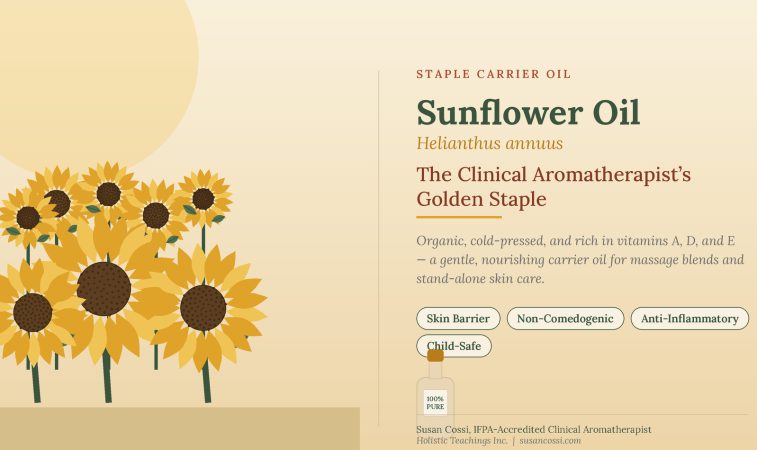
Sunflower Oil: The Clinical Aromatherapist’s Golden Staple
Helianthus annuus
There is something that warms my heart in autumn when I see the beauty of the sunflower. Walking through a field of them, their broad golden faces all turned the same direction, following the arc of the sun, is genuinely magical. It’s no wonder this flower has captured hearts and folklore for centuries. And it’s no coincidence that the oil pressed from its seeds has earned such a permanent place in my clinical practice.
Organic, cold-pressed sunflower oil is one of my true staples, both in the treatment room and at home. It’s a carrier oil that does its job beautifully and quietly, letting the essential oils shine while offering real therapeutic value entirely on its own.
What “Organic, Cold-Pressed” Actually Means, and Why It Matters
Not all sunflower oil is created equal. The bottle in most kitchen pantries has been refined, bleached, and deodorized using heat and chemical solvents, a process that strips away much of the nutritional value along with the natural golden color and light nutty scent.
Cold-pressed oil is mechanically extracted at low temperatures, with no solvents and no excessive heat. This gentler process preserves the oil’s full nutritional profile, its natural color, aroma, and biological activity.
Organic matters because sunflowers, like many oil-seed crops, can be treated with pesticides and grown from genetically modified seed. Choosing organic ensures the oil going onto your client’s skin, or your own, is as clean as the essential oils blended into it.
The Composition Behind the Benefits
Sunflower oil’s therapeutic reputation comes down to what’s actually in the bottle. Cold-pressed Helianthus annuus oil is rich in:
- Vitamins A, D, and E
- Minerals, including calcium, zinc, potassium, iron, and phosphorus
- Essential fatty acids, primarily linoleic acid (omega-6) and oleic acid
- Antioxidant compounds, including sesamol
This nutrient profile is what allows sunflower oil to move so easily between skincare, clinical support, and massage therapy.
Health Benefits: Skincare and Barrier Protection
- Strengthens the skin barrier. High in linoleic acid, it replenishes the skin’s natural lipids and helps prevent transepidermal moisture loss, keeping the complexion supple.
- Provides intense hydration. As an effective natural emollient, it traps moisture within skin cells, making it ideal for dry, sensitive, or weather-worn skin.
- Non-comedogenic. With a comedogenic rating of zero, it won’t clog pores and can be used safely on all skin types, including oily and acne-prone skin.
- Combats premature aging. Its vitamin E content neutralizes free radicals, shields skin from environmental stressors, and helps minimize the appearance of fine lines.
- Soothes inflammation. Its anti-inflammatory properties offer real relief for irritated skin conditions such as eczema, psoriasis, and rosacea.
- Supports wound healing. Compounds like sesamol and oleic acid stimulate cellular regeneration and support the recovery of damaged tissue.
Health Benefits: Hair and Scalp
- Manages frizz and enhances shine, conditioning hair strands deeply without leaving a heavy, greasy residue
- Nourishes the scalp, delivering nutrients directly to the roots to support a healthier environment for hair growth and reduce breakage
- Softens and combats dryness, thanks in part to its gamma-linolenic acid (GLA) content
Where Clinical and Dermatological Use Comes In
Because of this composition, sunflower oil shows up again and again in clinical, dermatological, and aromatherapeutic settings to support:
- Atopic dermatitis (eczema). Its high linoleic acid content preserves skin barrier function and improves hydration.
- Psoriasis. Its deep emollient properties and anti-inflammatory compounds soothe thick, itchy, scaling skin during flare-ups.
- Xerosis (severely dry skin). Unlike some oils that disrupt the skin barrier, sunflower oil reinforces the lipid bilayer and helps prevent water loss.
- Acne vulgaris. Its zero comedogenic rating allows it to help balance sebum and ease inflammation without blocking pores.
- Minor wounds and scars. Vitamins A and E support tissue regeneration and cellular repair.
- Joint inflammation. Used as a massage base, its anti-inflammatory fatty acids can absorb transdermally to help ease aching joints and localized swelling.
- Gentle, child-safe formulations. Its mild nature makes it well suited to delicate skin, baby massage, and easing cradle cap or infant dryness.
A note on research depth: some of the strongest clinical evidence for sunflower oil comes from studies in preterm infant care, where topical application supported skin barrier function in delicate neonatal skin. This is a good reminder of just how gentle and dependable this oil truly is, even for the most vulnerable skin.
Using Sunflower Oil in a Massage Blend
As a carrier, sunflower oil is typically diluted with essential oils at a 1 to 3 percent concentration for general massage (roughly 6 to 18 drops per 30 ml), adjusting down for sensitive populations. Its light, fast-absorbing nature makes it especially well suited to:
- Full-body relaxation massage, where glide and comfort matter over long strokes
- Facial blends, since it won’t clog pores the way heavier oils can
- Blends for clients with easily irritated or reactive skin
- Localized joint and muscle work, where its anti-inflammatory fatty acids can support the treatment’s aim
Using Sunflower Oil as a Stand-Alone Treatment
Sunflower oil doesn’t need essential oils added to earn its place in a treatment. Used on its own, it offers real value:
- As a facial or body moisturizer for dry or compromised skin
- As a gentle makeup remover and cleansing oil
- Applied to cuticles and dry patches for softening
- As a pre-massage skin conditioner on clients with very dry skin before introducing an essential oil blend
- In infused oil preparations, where herbs like calendula, chamomile, or arnica are steeped in sunflower oil to create a therapeutic base oil for topical use
What the Sunflower Represents
Beyond the bottle, the sunflower carries a rich symbolic and magical history that some practitioners like to weave into their practice and intention-setting.
The sunflower’s defining trait, its heliotropism (the way young blooms turn to follow the sun across the sky), has made it a universal symbol of:
- Warmth, vitality, and life force, tied to solar energy and the element of Fire
- Loyalty and devotion, drawn from its faithful turning toward the sun
- Joy, optimism, and positivity, simply from its bright, open-faced form
- Longevity and strong harvests, in many folk traditions tied to abundance
- Truth and honesty, since the flower is thought to “hide nothing,” always facing the light
In folk magic and plant lore, sunflowers have been used or carried for
- Confidence and courage, worn or carried to bolster inner strength
- Fertility and abundance, thanks to the flower’s many seeds, tied to prosperity
- Wish fulfillment, in some Native American traditions, where sunflower seeds were offered with a wish in mind
- Protection and cleansing, with the seeds and petals used in charms meant to clear negativity and invite light into a space
- Honoring solar deities, appearing in seasonal rites and sun-festival traditions marking the height of summer
For clinical practitioners who also draw on this symbolism, working with sunflower oil can become a small ritual of intention: a light, sun-colored oil that mirrors the very qualities, warmth, vitality, and openness, that a treatment is meant to support.
A Practical, Grounded Staple
At the end of the day, sunflower oil earns its place in my practice for the most practical of reasons: it’s gentle, non-comedogenic, richly nourishing, and dependable across skin types and life stages, from infants to those managing chronic skin conditions. That it also carries centuries of symbolism around light, vitality, and joy is simply a lovely thread woven through a very grounded, evidence-backed oil.
Susan Cossi
IFPA-Accredited Clinical Aromatherapist and Holistic Health Practitioner | Holistic Teachings Inc. | susancossi.com
This article is for educational purposes and isn’t a substitute for medical advice. Always patch test new oils and consult a qualified healthcare provider or aromatherapist regarding individual skin conditions or sensitivities.