FUN FACT BLOG · MIDSUMMER EDITION
June 21st
The Longest Day Has the Deepest Magic
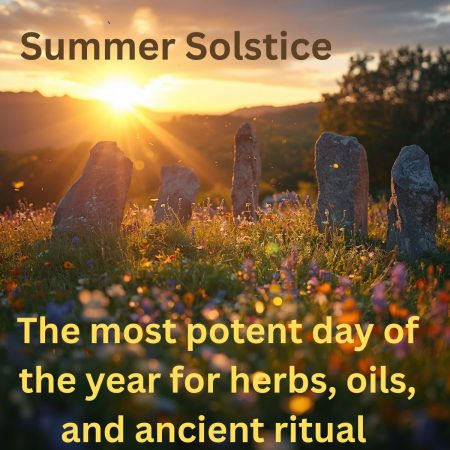
What makes the summer solstice the most potent day of the year for herbs, oils, and ancient ritual — and what you can actually do about it.
What Actually Happens on June 21st?
The summer solstice is the moment Earth’s axial tilt points the Northern Hemisphere most directly toward the sun. The result? The longest day of the year — roughly 17 hours of daylight in Canada — and the shortest night. It’s the astronomical peak of summer, celebrated across virtually every ancient culture on earth.
| ✨ Fun Fact: The word “solstice” comes from the Latin sol (sun) and sistere (to stand still). For a brief moment, the sun appears to pause in the sky before reversing its northward journey. The ancient world found this terrifying and wonderful in equal measure. |
Stonehenge aligns perfectly with the solstice sunrise. The Norse celebrated Midsommar. Indigenous peoples across the Americas held sacred sun ceremonies. And across medieval Europe, June 21st was considered the single most powerful day for herbalism, folk magic, and botanical medicine.
The Magic Herbs of Midsummer
For centuries, herbalists believed that plants harvested on the solstice — especially at dawn or noon — were at their absolute peak of potency. Modern science actually backs part of this up: solar intensity drives higher concentrations of volatile oils and active compounds in many herbs.
| Herb | Folklore & Tradition | Modern Use |
| St. John’s Wort | Blooms at midsummer; hung above doors to repel negativity. | Studied for mood support; peak hypericin in June blooms. |
| Lavender | Burned in Celtic midsummer bonfires for purification and good fortune. | Aromatherapy, sleep support, skin care. |
| Chamomile | Sacred to the sun in Norse and Egyptian traditions. Rolling in fields was considered lucky. | Calming teas, anti-inflammatory skin care. |
| Mugwort | Placed under pillows to unlock prophetic dreams on the longest night. | Dream herb, digestive support, smudging. |
| Vervain | Called “herb of grace” by Druids. Harvested at solstice, never with iron tools. | Nervine tonic, relaxation. |
| Calendula | Floated in midsummer water bowls for skin rituals. | Salves, infused oils, wound healing. |
| 🌱 Wild fact: Shakespeare set A Midsummer Night’s Dream on June 21st deliberately — the night was genuinely believed to make people susceptible to enchantment, visions, and fairy interference. The herb juice used on sleeping Titania’s eyes? Based on real folk practice with love-in-idleness (wild pansy), used in solstice love magic. |
Essential Oils & Solstice Blending
The solstice is traditionally the ideal time to make infused oils, tinctures, and herbal blends — and also to charge or “set intentions” in the oils you already have. Here is a guide to which oils are associated with midsummer energy:
| Essential Oil | Traditional Association | How to Use on June 21st |
| Frankincense | Solar energy, spiritual amplification | Diffuse at noon when the sun peaks; anoint the crown of the head. |
| Bergamot | Abundance, joy, summer vitality | Add to a midsummer bath with dried calendula petals. |
| Rosemary | Memory, clarity, protection | Make a solar-infused oil by steeping fresh sprigs in carrier oil in a sunny windowsill all day. |
| Lemon | Purification, renewal, light | Mix with water to make a midsummer floor wash — start from the back of your home toward the front door. |
| Rose | Love, the heart, midsummer unions | Anoint candles or write intentions on paper before burning at sunset. |
| Juniper Berry | Protection, releasing what no longer serves | Burn dried juniper alongside midsummer bonfires (or a candle flame). |
| ☀️ Solar infusion tip: Place a glass jar of carrier oil (sunflower, jojoba, or sweet almond) with fresh herbs outside on June 21st from sunrise to sunset. The long hours of intense UV light accelerate extraction in a single day. This is called a “solar maceration.” |
What to Actually Do on June 21st
Whether you’re drawn to the folklore or just love an excuse to spend a beautiful midsummer’s day intentionally, here are some grounded, genuinely lovely things to try:
- (around 5:15 AM in Alberta!) and spend a few quiet minutes outside. Many traditions hold that solstice morning dew has special properties — washing your face with it was considered a beauty and luck ritual across Celtic and Slavic cultures.
- Fill a clear glass jar with water and leave it in full sunlight from dawn to dusk. Add a crystal like citrine or carnelian if you like. Use the water to mist your plants, add to a bath, or drink mindfully in the evening.
- — lavender, rosemary, chamomile, St. John’s Wort — and make a simple wreath or bundle. Hanging dried herbs above your door is one of the oldest protective traditions in European folk magic.
- using the method above. Leave it in the windowsill or garden all day. Rosemary in sunflower oil is an excellent beginner’s blend.
- The sun at its zenith was considered the moment of greatest clarity and power. Write an intention, a gratitude, or something to release — then burn the paper at sunset or save it under a candle.
- and let it burn until it goes out. Yellow or gold candles are traditional, but any candle you love works perfectly.
- Dry a small handful of mugwort, tuck it in a cloth under your pillow, and pay attention to your dreams on the longest night of the year.
The Science Behind the Magic
Here’s the part that makes it all a little more interesting: the folklore wasn’t entirely wrong.
Many medicinal plants do reach peak volatile oil content around the summer solstice. Lavender’s linalool concentration is highest when the flowers first fully open — which happens around midsummer in most climates. St. John’s Wort’s active compound hypericin peaks in flowering tops harvested at full bloom in June. And the extended UV exposure of the longest day genuinely does accelerate photosynthesis and secondary metabolite production in sun-loving herbs.
| 🧪 Science fun fact: The term “heliotropism” describes how plants orient toward light — and midsummer is the extreme test of this. Sunflowers famously track the sun daily when young. Ancient observers likely noticed this movement and interpreted it as the plant being “alive” with solar energy. They weren’t entirely wrong about the energy part. |
Whether the magic is metaphorical, meteorological, or something else entirely — the solstice is genuinely the best day of the year to be outdoors, hands in the dirt, nose in the herbs, watching the light stretch on past 9 PM.
“However you spend it — in the garden, watching the sunset, or simply noticing the light —
June 21st is asking you to pay attention.
That’s the oldest magic there is.”
☀️