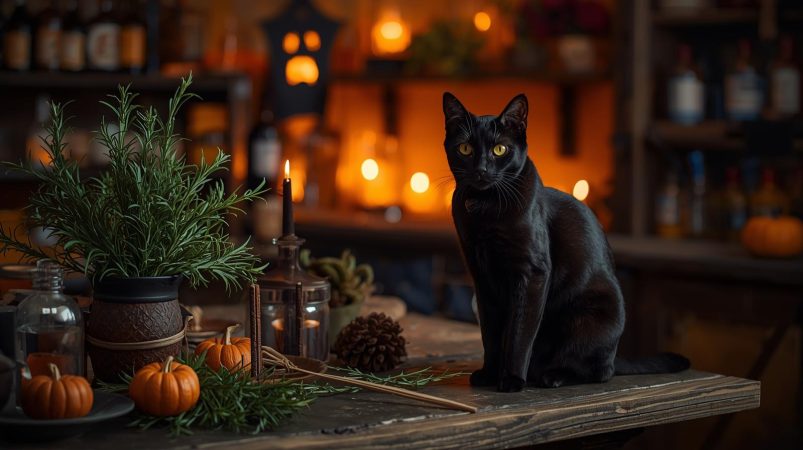
The veil between worlds grows thin as autumn deepens. On the night of October 31st, when darkness arrives early and the wind carries whispers of the past, we celebrate a festival that stretches back through millennia—a night known by many names, but recognized everywhere by its peculiar magic: Hallowe’en.
Ancient Origins: When the Dead Walked Among Us
Long before plastic skeletons adorned suburban lawns, the Celtic people of Ireland, Britain, and northern France marked this night as Samhain (pronounced “sow-win”), meaning “summer’s end.” For them, October 31st represented something far more profound than a holiday—it was a rupture in reality itself.
The Celts believed that on this night, the boundary separating the living from the dead dissolved. Spirits could cross over, wandering the earth alongside mortals. But these weren’t necessarily malevolent entities—they were ancestors, lost souls, and occasionally, something far stranger. To appease these visitors, people left out food and drink. They lit enormous bonfires atop hills, their flames visible for miles, serving as beacons to guide friendly spirits and ward off harmful ones.
What’s truly mysterious is how accurately ancient peoples seemed to sense something liminal about this time of year. Was it simply the dying of the harvest season, or did they perceive something deeper—some astronomical or terrestrial phenomenon we’ve since forgotten?
The Christian Transformation: All Saints and Hidden Meanings
In the 8th century, Pope Gregory III made a calculated move. Rather than suppress the stubborn pagan festival, the Church absorbed it. November 1st became All Saints’ Day (or All Hallows’ Day), and the evening before became “All Hallows’ Eve”—eventually contracted to “Hallowe’en.”
But here’s where it gets intriguing: November 2nd became All Souls’ Day, dedicated to praying for the dead. The Church had essentially preserved the ancient belief that this was a special time for communing with those who had passed beyond. The packaging changed, but the essence remained hauntingly similar.
The Botanical Guardians: Plants That Protect Against Evil
For centuries, humans have turned to the plant kingdom for protection against malevolent forces. On Hallowe’en, when spirits roamed freely, specific herbs and their essences were considered powerful shields against evil. These weren’t mere superstitions—many of these plants contain compounds that affect consciousness, perception, and even physiological responses, blurring the line between folklore and pharmacology.
Rosemary: The Remembrance Guardian
Rosemary (Rosmarinus officinalis) was burned in homes and worn as crowns during Samhain. The woody, camphoraceous smoke was believed to purify spaces and prevent evil spirits from entering. Medieval Europeans placed rosemary sprigs under pillows on Hallowe’en to ward off nightmares and demonic visitors.
The essential oil, rich in cineole and camphor, was dabbed on doorways and windowsills—the traditional entry points for unwanted spirits. Curiously, modern research shows rosemary oil has powerful antimicrobial properties and affects brain chemistry, potentially explaining why people felt “clearer” and “protected” in rosemary-scented spaces.
Mystery: Why was rosemary called “the herb of remembrance”? Some say it helped the living remember protective prayers. Others whisper it helped spirits remember their way to the afterlife, preventing them from lingering.
Mugwort: The Witch’s Herb
Mugwort (Artemisia vulgaris) holds a dark reputation. Druids burned it during Samhain rituals, and its smoke was said to reveal spirits invisible to the naked eye. Medieval grimoires instructed practitioners to stuff pillows with mugwort on Hallowe’en to induce prophetic dreams—or to see demons in their true form.
The essential oil, extracted from the silvery leaves, was mixed with oil and rubbed on the body as “spirit armor.” German folklore warned never to harvest mugwort after Michaelmas (September 29th), as the Devil would spit on the plants, cursing anyone who used them.
Fun Fact: Mugwort contains thujone, the same compound found in absinthe, which can cause vivid hallucinations in high doses. Were the “spirits” people saw on Hallowe’en actually chemically-induced visions? The line between mysticism and pharmacology grows disturbingly thin.
Frankincense: The Sacred Smoke
Frankincense resin, burned for thousands of years in religious ceremonies, was considered essential for Hallowe’en protection. The Catholic Church adopted this ancient practice, using frankincense during All Saints’ Day masses—but the custom predates Christianity by millennia.
The essential oil, steam-distilled from the resin of Boswellia trees, was anointed on foreheads, throats, and hearts—the body’s vulnerable “gates” where spirits might enter. Middle Eastern traditions held that frankincense smoke could not only repel demons but could make them visible, forcing them to reveal themselves.
Chilling Detail: Frankincense trees grow in some of Earth’s harshest environments—barren cliffs and desert highlands. Ancient peoples believed only plants that thrived in “hellish” conditions could fight hellish entities.
Sage: The Cleanser of Shadows
White sage (Salvia apiciana) and common sage (Salvia officinalis) were burned to “smudge” homes before Hallowe’en night. Native American traditions and European folklore independently developed nearly identical practices: burning sage bundles and wafting the smoke into corners, closets, and doorways where shadows gathered.
The essential oil was mixed with water and sprinkled around property boundaries to create protective barriers. Scottish tradition dictated that sage must be cut with a silver knife under a full moon to maximize its protective power.
Mystery: Indigenous Americans and medieval Europeans, separated by an ocean and with no contact, both concluded sage could purify space and repel evil. Coincidence, or did sage genuinely possess properties our ancestors perceived but we no longer recognize?
Garlic: The Vampire’s Bane
While associated more with vampires than Hallowe’en spirits, garlic (Allium sativum) was hung in braids over doors and windows throughout Europe on October 31st. The essential oil, impossibly pungent and powerful, was rubbed on door frames and even on skin.
Romanian tradition held that evil spirits couldn’t cross a threshold marked with garlic oil. Greek Orthodox priests would bless garlic cloves on All Saints’ Day, which families would then press into keyholes and cracks in walls.
Fun Fact: Garlic contains allicin, which has genuine antimicrobial and antifungal properties. Medieval Europeans might not have understood germ theory, but they empirically observed that garlic-protected homes had fewer illnesses—which they attributed to evil spirits being repelled.
Lavender: The Gentle Shield
Lavender (Lavandula angustifolia) seems too gentle for Hallowe’en’s darkness, yet it was considered essential protection against the “gray spirits”—entities that weren’t evil but weren’t entirely benevolent either. These were the confused dead, lost souls, and melancholic ghosts who might attach themselves to the living.
The essential oil was worn in lockets or dabbed behind ears. Children were bathed in lavender water on Hallowe’en afternoon to make themselves “invisible” to dangerous spirits while remaining “visible” to protective ancestors.
Mystery: Why did dozens of cultures believe lavender created selective spiritual invisibility? Modern aromatherapy confirms lavender reduces anxiety and promotes calm—perhaps the protection wasn’t from external spirits but from internal fear.
Juniper: The Purifying Fire
Juniper (Juniperus communis) branches were burned in Scotland and across Northern Europe during Samhain. The wood crackles and spits when burned, and the ancients believed these sounds were evil spirits being driven away. The essential oil, derived from the berries, was mixed into ritual oil lamps burned throughout Hallowe’en night.
German folklore warned that juniper must never be allowed to go out once lit—if the flame died before sunrise, the house would be vulnerable. Families would take turns tending the juniper fire all night.
Chilling Detail: Juniper contains compounds that are mildly psychoactive and can induce trancelike states when inhaled in concentrated smoke. Were the spirits people claimed to see actually chemically-induced hallucinations?
Wormwood: The Necromancer’s Ally
Wormwood (Artemisia absinthium), frankincense’s darker cousin, occupies an ambiguous space in Hallowe’en lore. Some traditions said it attracted spirits, making them visible and communicative. Others claimed it repelled them with its bitter essence.
Medieval necromancers would anoint themselves with wormwood essential oil before attempting to commune with the dead. The plant’s Latin name, absinthium, shares its root with “absinthe”—the infamous “green fairy” liquor blamed for driving artists mad.
Warning from the Wise: Grimoires instructed that wormwood should only be used by those who wanted to see beyond the veil. For ordinary folk seeking protection, wormwood was considered dangerously unpredictable—a plant that opened doors better left closed.
The Protective Blend: What Grandmothers Knew
In rural areas of Ireland, Scotland, and Appalachia, wise women would prepare protective oil blends before Hallowe’en. While recipes varied, they commonly included:
- Rosemary (for clarity and protection)
- Frankincense (for sacred blessing)
- Lavender (for peace and selective invisibility)
- Clove (for its fierce, warming energy that evil “couldn’t penetrate”)
These blends were anointed on doorways, window sills, and family members. The ritual of application mattered as much as the oils themselves—protection required intention, not just ingredients.
Fun Fact: Many of these traditional “protection oils” are now sold as “spiritual protection blends” or “cleansing oils” in metaphysical shops. The formulas are nearly identical to those used centuries ago, though the sellers may not know they’re preserving ancient Hallowe’en traditions.
Jack-O’-Lanterns: The Strange Tale of Stingy Jack
Every carved pumpkin glowing on a doorstep carries within it a dark Irish legend. According to folklore, a miserly blacksmith named Jack O’Lantern tricked the Devil—not once, but twice. When Jack finally died, Heaven wouldn’t accept him (he was far too wicked), but the Devil, still smarting from being outwitted, refused him entry to Hell as well.
Condemned to wander the earth eternally, Jack was given only a burning coal to light his way. He placed it inside a carved turnip and became a wandering spirit, forever trapped between worlds. The Irish began carving frightening faces into turnips and potatoes to ward off Jack and other malevolent spirits. When Irish immigrants arrived in America, they discovered pumpkins—larger, softer, easier to carve—and a tradition was reborn in brilliant orange.
Fun Fact: The original jack-o’-lanterns were absolutely terrifying. Victorian-era photographs show turnip lanterns carved with grotesque, nightmare-inducing faces that make modern pumpkins look friendly by comparison.
Mysterious Customs That Defy Explanation
The Dumb Supper
In parts of Appalachia, families once held “dumb suppers” on Hallowe’en—elaborate meals eaten in complete silence, with a place set for deceased family members. No one could speak until the meal ended, lest they offend the spirits in attendance. Those brave enough reported seeing shadows move in empty chairs, or feeling the temperature drop around the vacant seat.
Soul Cakes and the Origins of Trick-or-Treating
Medieval children would go door-to-door on All Souls’ Day, singing and praying for the dead in exchange for “soul cakes”—sweet pastries marked with a cross. Each cake eaten was believed to free a soul from Purgatory. This evolved into “guising” in Scotland and Ireland, where children wore costumes and performed tricks or songs for treats.
But why costumes? Some historians believe people disguised themselves to avoid being recognized by wandering spirits. Others suggest they dressed as the dead themselves—a form of sympathetic magic, becoming what they feared to gain power over it.
Fun Fact: The phrase “trick or treat” didn’t appear in print until 1927, and didn’t become widespread until the 1950s. Before that, children used more threatening phrases like “Help the poor!” or simply “Anything for Hallowe’en?”
The Black Cat Paradox
Black cats are inseparable from Hallowe’en imagery, yet their story is one of tragic contradictions. In medieval Europe, they were considered witches’ “familiars”—demonic entities in animal form. During the witch trials, thousands of black cats were slaughtered alongside their owners.
Yet in ancient Egypt, black cats were sacred, and in parts of England and Scotland, a black cat crossing your path was considered extraordinarily lucky. In Japan, they’re still symbols of good fortune. How did the same creature become both blessed and cursed?
Chilling Mystery: During the Black Death in Europe (1347-1351), the mass killing of cats—believed to be witches’ servants—allowed rat populations to explode, making the plague spread faster. The superstition literally fed the apocalypse.
The Witching Hour: When Time Holds Its Breath
Traditional folklore insists that supernatural activity peaks at 3 AM, but on Hallowe’en, the entire night becomes a “witching hour.” Divination practices—attempts to glimpse the future or communicate with spirits—were performed with eerie regularity.
Young women would stand before mirrors at midnight, eating an apple while brushing their hair, hoping to see their future husband’s face appear behind them. Others would peel an apple in one long strip and throw the peel over their shoulder, believing it would form the initial of their true love. If you saw a skull instead of a face, you were doomed to die unmarried.
In parts of Wales, people would mark stones and throw them into bonfires. If your stone couldn’t be found the next morning, you wouldn’t survive the year.
Fun Fact: “Snap apple” was a popular Hallowe’en game where apples were suspended on strings and participants tried to bite them without using their hands. Sounds innocent until you learn the apples were sometimes stuck with pins or razors as a “test of courage.” (Not recommended for modern parties.)
The Mystery of Mass Coincidence
Why do so many cultures, separated by vast distances, have festivals honoring the dead at nearly the same time? Mexico’s Día de los Muertos (November 1-2), Japan’s Obon (mid-August, but sometimes October), and China’s Ghost Festival all serve similar purposes: honoring ancestors and acknowledging the thin places where worlds meet.
Is this simply agricultural timing—the end of harvest, the onset of winter’s death? Or is there something about the planetary alignment, the shortening days, the quality of October light that humans across time and space have instinctively recognized as significant?
Modern Mysteries
Today, Hallowe’en is America’s second-largest commercial holiday, generating over $10 billion annually. Yet beneath the commercial veneer, something of the old magic persists. People still feel it—that electric charge in the October air, the sense that tonight, the impossible might just be possible.
Scientists have noted increased reports of paranormal experiences around Hallowe’en, though whether this is psychological expectation or something more remains hotly debated. Hospital emergency rooms consistently see increased admissions on October 31st, though the causes are disturbingly varied and often unexplained.
Final Fun Fact: Ireland, where Hallowe’en began, traditionally baked a barmbrack, a fruitcake containing hidden objects: a ring (marriage), a coin (wealth), a thimble (spinsterhood), and a piece of cloth (poverty). Your slice revealed your fate for the coming year. Modern versions exclude the more unsettling prophecies.
The Lingering Question
As you carve your pumpkin this October 31st, as you hear children’s laughter mingling with autumn wind, consider this: every tradition we practice—no matter how commercialized—originated in genuine fear, genuine wonder, genuine belief that on this night, the rules that govern our world are suspended.
The ancient Celts lit their fires against the dark. We light our jack-o’-lanterns. Different times, same instinct. Perhaps they knew something we’ve forgotten, or perhaps we remember something we can’t quite articulate.
And if you catch the scent of rosemary smoke drifting through October twilight, or notice a sprig of dried lavender hanging above an old doorway, know that someone, somewhere, still practices the old protections. Whether against genuine spirits or the very human fears they represent, the botanical guardians continue their watch.
Either way, when darkness falls on Hallowe’en night, the world feels different. And maybe, just maybe, it actually is.
Keep your pumpkin burning bright, and your protective herbs close. You never know who—or what—might be looking for the light.