The Ancient Art of
Chinese Cupping Therapy
5,000 years of healing wisdom — where suction meets science, and tradition meets transformation
| INTRODUCTION Imagine a therapy so powerful it has been trusted for millennia — from ancient Egyptian physicians to Olympic gold medalists. Chinese cupping therapy is not just a trend; it is a time-tested healing modality that works with your body’s own energy pathways to restore balance, release tension, and unlock vitality. Those mysterious circular marks left on Olympic athletes? Not bruises — they are maps of your body’s stagnation, trauma, and toxin release. Ready to discover what cupping is truly all about? |
What is Chinese Cupping Therapy?
Cupping therapy is a form of alternative medicine originating in Traditional Chinese Medicine (TCM) where special cups are placed on the skin to create suction. This negative pressure draws up the underlying tissue, increasing blood flow, loosening fascia, and stimulating the flow of Qi (vital energy) through the body’s meridian pathways.
The suction created breaks up stagnation, encourages fresh oxygenated blood to reach targeted areas, and supports the lymphatic system in clearing metabolic waste. In TCM terms, cupping resolves what practitioners call Bi Syndrome — the painful obstruction of Qi and Blood.
Types of Cupping
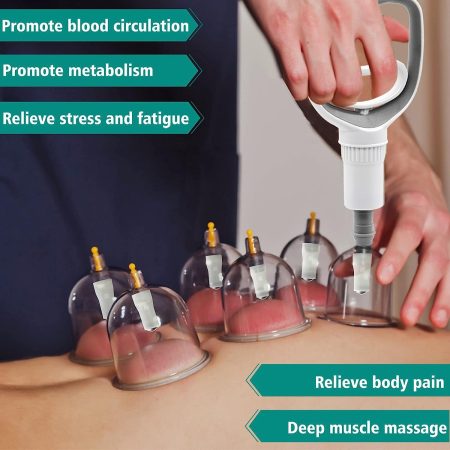
| 🔥 Fire Cups Traditional glass cups heated with a flame to create suction. The original, most dramatic method — still widely used by classical TCM practitioners. | 💨 Silicone Cups Modern flexible cups squeezed to create suction. Ideal for gliding/sliding techniques and self-treatment. Adjustable pressure. | ⚙️ Pump Cups Plastic cups with a hand pump for precise, controlled vacuum. Great for sensitive skin and clinical settings. | 💧 Wet Cupping Combines cupping with small micro-incisions for targeted toxin release. Advanced practitioners only — known as Al-Hijama in Islamic medicine. |
The Incredible Health Benefits
Cupping therapy offers a remarkable range of health benefits, addressing both physical and energetic aspects of wellbeing. Modern research continues to validate what TCM practitioners have observed for centuries:
| 🩸 Improved Circulation Dramatically increases local blood flow and lymphatic drainage to treated areas. | 💪 Pain Relief Eases muscle tension, back pain, neck stiffness, and chronic aches. |
| 🧘 Stress & Anxiety Activates the parasympathetic nervous system for deep relaxation. | 🫁 Respiratory Support Supports lung function, clears congestion, and helps with asthma. |
| 🌿 Detoxification Draws metabolic waste and stagnant fluids to the surface for removal. | ⚡ Energy & Qi Flow Clears blockages in meridians, restoring free flow of vital energy. |
| ✨ Skin Health Promotes collagen production, reduces cellulite, and rejuvenates tissue. | 🦴 Arthritis Relief Reduces joint inflammation and stiffness, increases range of motion. |
The Body’s Energy Map — Key Acupoints
In Traditional Chinese Medicine, cupping is applied along meridians — unseen channels through which Qi flows throughout the body.
Understanding these points allows practitioners to create precise, condition-specific protocols rather than a generalized approach. Each point has been identified and refined over thousands of years of clinical observation.
Cupping for Arthritis
Arthritis responds remarkably well to cupping therapy. By targeting the joints and surrounding meridian points, cupping reduces inflammation, breaks up stagnation (Bi Syndrome), and stimulates synovial fluid production to lubricate the joint.
Knee osteoarthritis — Is one of the most common presentations seen in clinical practice. The same approach can be adapted for hip, shoulder, and wrist arthritis by identifying the corresponding local and distal points.
Treatment Guidelines for Arthritis
- Session duration: 10–15 minutes per placement
- Cup retention: 5–10 minutes stationary, or gliding technique for broader coverage
- Frequency: 2–3 sessions per week initially, reducing to maintenance as symptoms improve
- Suction level: Gentle to medium — never strong suction directly over joints
- Contraindications: Active skin infection, open wounds, varicose veins, bleeding disorders
- Always combine with TCM diagnosis — Cold-type Bi requires warming methods; Heat-type Bi requires lighter suction
- Optional: Combine with essential oils (eucalyptus, frankincense, ginger) for enhanced anti-inflammatory effect
| CLINICAL CAUTION IMPORTANT: This protocol is provided for educational purposes only. Always seek treatment from a licensed and qualified TCM practitioner or registered healthcare professional. Cupping should complement, not replace, your existing medical care. Never apply cups over inflamed, broken, or infected skin. |
Fun Fact — The Olympic Cupping Explosion!
| ⚡ FUN FACTS ABOUT CUPPING When Olympic swimmer Michael Phelps appeared at the 2016 Rio Olympics covered in purple circular marks, the world suddenly became fascinated with cupping! Internet searches for ‘cupping therapy’ spiked by over 300% overnight, and practitioners around the globe reported unprecedented demand. But here’s the real kicker — Phelps wasn’t doing anything new at all! Chinese athletes had been using cupping to enhance performance and recovery for thousands of years before it hit the Olympic spotlight. The 2016 Games simply gave the Western world its first viral introduction to an ancient tradition. Other fun facts: The ancient Egyptians used animal horns as the first ‘cups.’ The term ‘cupping’ comes from the Latin ‘cuppam’ meaning cup or tub. In China, cupping is sometimes called ‘ba guan’ meaning ‘pulling open the vessel.’ And the colourful marks left behind? They typically fade within 3–10 days and are considered by TCM practitioners to be diagnostic — darker marks indicate greater stagnation in that area. |
A Blazing History — 5,000+ Years of Cupping
Cupping is one of humanity’s oldest therapeutic practices, with documented use spanning nearly every major ancient civilization. Far from being a fringe treatment, it was mainstream medicine for millennia.
| ~3000 BCE | Ancient Egyptians documented cupping in the Ebers Papyrus — one of the world’s oldest medical texts — recommending it for fever, pain, and imbalances of blood. |
| ~1000 BCE | Chinese physician Ge Hong wrote about horn cupping (using hollowed animal horns) to treat pulmonary tuberculosis. The practice became formalized within TCM theory. |
| 700–900 CE | Cupping spreads along the Silk Road. Islamic physicians including Ibn Sina (Avicenna) documented its use extensively in ‘The Canon of Medicine,’ calling it a cornerstone of preventive health. |
| 1600–1800 CE | European physicians adopted wet cupping widely. Glass cups replaced animal horns. Barber-surgeons in England and France used cupping for almost every ailment imaginable. |
| 1950–2000 | Cupping was formally integrated into Chinese hospital practice. Modern silicone and pump cups emerged. The global wellness boom of the 1990s brought cupping to broader awareness. |
| 2016 & Beyond | The ‘Michael Phelps Effect’ at the Rio Olympics exploded global awareness. Over 135 clinical studies on cupping were published within a decade, validating ancient wisdom with modern science. |
The Science Speaks — Research Backing
Modern science is steadily validating what TCM practitioners have known for millennia. The evidence base for cupping has grown dramatically, with over 135 peer-reviewed studies published in the past decade alone. Here are five landmark findings:
| # | Study / Journal | Key Finding |
| 1 | Journal of Traditional Chinese Medicine (2015) — Systematic Review | A review of 32 randomized controlled trials found cupping therapy significantly reduced chronic neck and back pain compared to conventional treatments, with effects lasting up to 3 months post-treatment. |
| 2 | PLoS ONE (2018) — Inflammation Study | Researchers found cupping modulated prostaglandin I2 and TNF-alpha levels, demonstrating measurable anti-inflammatory effects at a cellular level — explaining relief experienced in arthritis and fibromyalgia. |
| 3 | Evidence-Based Complementary Medicine (2017) — Circulation Study | Doppler ultrasound studies confirmed cupping increases local blood perfusion by up to 40% in treated areas, directly validating the TCM concept of ‘invigorating blood and removing stasis.’ |
| 4 | International Journal of Sports Medicine (2022) — Athletic Recovery | Elite athletes receiving cupping showed 23% faster muscle lactate clearance and significantly reduced delayed onset muscle soreness (DOMS) compared to control groups. |
| 5 | Cephalalgia (2020) — Migraine Meta-Analysis | A meta-analysis of 16 clinical trials found wet cupping reduced migraine frequency and intensity significantly, particularly when applied to DU14 and GB21 — points identified in TCM over 2,000 years ago. |
The convergence of ancient meridian theory with modern understanding of blood flow, inflammation, and the nervous system is one of the most exciting frontiers in integrative medicine. As research methodologies improve and cultural biases dissolve, cupping’s place in evidence-based practice continues to strengthen.
Ready to Experience Cupping?
Whether you’re managing chronic pain, seeking athletic recovery, or simply curious about this ancient practice, cupping therapy offers a powerful, natural path toward balance and vitality. The wisdom of 5,000 years is ready to work for you.
susancossi.com | Holistic Teachings Inc.
This article is for educational purposes only. Always consult a qualified TCM practitioner or holistic healthcare provider for personalized treatment.