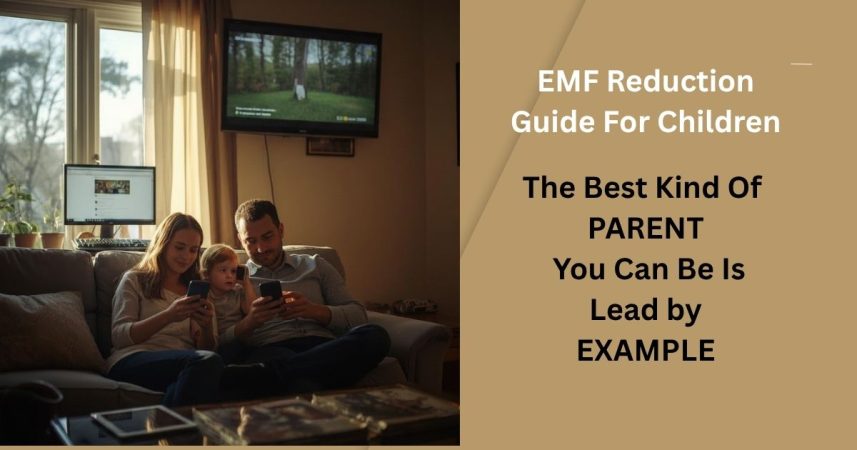
Reducing EMF Exposure: Protecting Children from Electromagnetic Overload
A quick, evidence-informed guide to symptoms, causes, and proven solutions for lowering everyday EMF exposure at home.
At a Glance: Symptoms & Solutions
| Common Symptom | Simple Solution |
| Trouble falling asleep / restless sleep | Use airplane mode or turn phone off at night; keep devices out of the bedroom |
| Headaches or eye strain after screen time | Set daily device limits; take 20-20-20 breaks |
| Irritability, poor focus, hyperactivity | Create tech-free zones (meals, bedrooms); increase outdoor time |
| Worsening ADHD/ADD symptoms (inattention, impulsivity) | Enforce no-screens-before-bed; cap recreational screen time; prioritize sleep and exercise |
| Meltdowns or irritability after screen time ends (‘tech withdrawal’) | Use visual timers and a consistent wind-down routine before screens end |
| Tingling, warmth near phone use | Use speaker/headphones; keep phone off the body |
| Frequent headaches near Wi-Fi router | Move router away from beds/desks; turn off Wi-Fi overnight |
| Anxiety or low mood tied to social media/device use | Limit social app access; encourage in-person play and outdoor time |
What Is EMF Overload?
Electromagnetic fields (EMFs) are invisible energy waves produced by electrical devices, Wi-Fi routers, cell phones, power lines, and smart home equipment. “Overload” happens when the body absorbs more of this energy than it can comfortably process — especially with the constant, layered exposure common in modern homes.
Why Children Are More Vulnerable
- Thinner skulls and higher tissue conductivity mean radiofrequency energy penetrates more deeply.
- Developing nervous systems are more sensitive to environmental stressors during childhood and adolescence.
- Longer lifetime exposure: children using devices today will accumulate far more cumulative EMF exposure than any prior generation.
Source: Frontiers in Pediatrics (2021) notes that children’s nervous systems are more susceptible than adolescents’ to EMF effects.
What the Research Shows
The evidence on EMF and children’s health is still developing, but several major bodies have issued precautionary guidance:
- The World Health Organization’s International EMF Project has examined whether extremely low frequency (ELF) magnetic field exposure is linked to increased childhood cancer incidence.
- In 2011, the WHO’s International Agency for Research on Cancer (IARC) classified radiofrequency EMF as “possibly carcinogenic to humans” (Group 2B).
- Following its 2004 international workshop on children’s EMF sensitivity, the WHO recommended reducing personal EMF exposure and minimizing it in schools, kindergartens, and other places children spend significant time.
Sources: WHO International EMF Project; IARC Monograph 102 (2011), cited in the MOBI-Kids Study Protocol, NIH/PMC.
Health Conditions Linked to EMF Overload
Research findings vary in strength, but the following conditions appear most often in the scientific literature on EMF exposure:
- Childhood leukemia: the strongest and most consistent association, observed in residential studies of extremely low frequency (ELF) magnetic fields from power lines and household wiring.
- Brain tumors: prompted the IARC’s 2011 classification of radiofrequency EMF as a Group 2B “possible” human carcinogen; the ongoing MOBI-Kids study is examining this risk specifically in young people.
- Sleep disruption: nighttime RF and blue-light exposure from devices delays melatonin release and reduces sleep quality.
- Headaches and eye strain: commonly self-reported with prolonged screen and device use.
- Concentration and behavioral effects: some studies link heavy device exposure to reduced attention and increased restlessness in children, though findings are inconsistent.
- Electromagnetic hypersensitivity (EHS): a cluster of symptoms — fatigue, tingling, headaches — some individuals report in connection with EMF exposure; not yet medically confirmed as causally linked.
Note: The WHO recommends precaution given their developing nervous systems and longer cumulative exposure.
ADHD / ADD: How Electronics Make It Worse
ADHD is a multifactorial neurodevelopmental condition — electronics don’t cause it, but a growing body of research shows screen and device overload reliably worsens symptoms in children who already have it:
- Inattention and hyperactivity: a 2026 narrative review of 14 studies (2018–2024) found excessive, unstructured screen time consistently associated with worsening inattention and hyperactivity in children and teens with ADHD.
- Dopamine-driven reward seeking: fast-paced, high-stimulation content delivers steady dopamine hits to the brain’s reward center, which can intensify the attention-craving cycle already present in ADHD.
- Sleep as the key mediator: French and Chinese studies (374 and large cohort samples) found nighttime screen use disrupted sleep, which directly worsened next-day ADHD symptom severity — sleep loss appears to be the strongest link between screens and worse ADHD outcomes.
- COVID-era data: a caregiver survey found 90% of families with an ADHD-diagnosed child reported screen overload, and increased recreational screen time tracked directly with worsening symptom severity.
- Brain development: a large longitudinal study (ABCD study, ~10,000 children ages 9–10 followed 2 years) linked higher baseline screen time to ADHD symptom changes mediated by measurable differences in brain structure.
Sources: Sage Journals narrative review (2026); Frontiers in Psychiatry Mendelian randomization study (2024); PMC COVID-19 ADHD screen time study; WebMD/Child Mind Institute; ABCD study brain-structure analysis.
Practical takeaway: for children with ADHD or ADD, screen-time limits and a strict no-screens-before-bed rule tend to produce the biggest symptom improvement of any single change — more so than reducing EMF exposure alone.
What Other Organizations Say
- American Academy of Pediatrics (AAP): recommends limiting children’s cell phone use, favoring text/speakerphone over holding phones to the head, and has formally petitioned the FCC to tighten radiofrequency exposure limits, citing children’s thinner skulls and greater radiation absorption.
- Environmental Health Trust (EHT): a research and policy nonprofit that compiles international medical and government recommendations and advocates for wired-first classroom technology and school EMF policies.
- Massachusetts Medical Society & Maryland Children’s Environmental Health Council: have passed resolutions calling for continued independent research and, in Maryland’s case, recommended wired internet over Wi-Fi in classrooms.
- BioInitiative Report (international scientist/public health working group): an independent review of over 1,800 studies, arguing existing exposure limits do not adequately protect against long-term, low-level biological effects.
- FCC / ICNIRP: the bodies that set legal RF exposure limits; in 2013 the FCC opened a formal review of its radiofrequency limits, partly in response to AAP and advocacy group pressure, though current US limits remain those set in 1996.
Sources: Environmental Health Trust policy archive; HealthyChildren.org (AAP); BioInitiative Report; FCC Reassessment of Exposure to RF Electromagnetic Fields proceeding (2013).
Proven Methods That Reduce Exposure
- Distance: doubling the distance from a device cuts RF exposure roughly fourfold — keep phones and tablets off laps and out of pockets.
- Airplane mode at night: eliminates active RF transmission during sleep, the body’s primary repair window.
- Wired over wireless: use Ethernet cables and corded headsets/speakerphone instead of Wi-Fi and Bluetooth where practical.
- Router placement and timers: keep Wi-Fi routers away from beds and play areas, and turn them off overnight.
- Tech-free zones and time limits: device-free bedrooms and mealtimes reduce both EMF exposure and screen-related sleep disruption.
- Grounding (earthing): walking barefoot outdoors or using a conductive grounding mat connects the body to the Earth’s natural electrical charge.
Grounding & Other Complementary Therapies: What Evidence Exists
Grounding has the most research behind it among complementary EMF therapies, though studies remain small and need replication:
- Body-voltage reduction: a 2016 Journal of Alternative and Complementary Medicine study of 50 participants (ages 12–79) found grounding reduced AC body voltage roughly 58-fold compared to ungrounded states.
- Blood viscosity: Chevalier et al. (2013) found 2 hours of grounding significantly reduced blood viscosity and red blood cell clumping in 10 healthy adults — a small but notable cardiovascular marker.
- Sleep and cortisol: multiple small studies report improved sleep quality and more normalized cortisol rhythms with overnight grounding; a 2024 rodent study on earthing mats also showed increased REM/NREM sleep and antioxidant changes.
- Inflammation and healing: review papers (Oschman et al., 2015; Earthing Institute research archive) document case-level reductions in inflammation markers, theorized to result from electron transfer neutralizing free radicals.
Caveat: most grounding studies have small sample sizes and limited long-term follow-up. Researchers describe the evidence as “promising but preliminary” — worth trying (it’s low-risk), but not yet a proven medical treatment.
Other supportive, lower-evidence practices worth knowing about:
- Antioxidant-rich nutrition: diets high in vitamin C, E, and polyphenols are theorized to help offset EMF-associated oxidative stress, based on general oxidative-stress research rather than EMF-specific trials.
- EMF shielding fabrics/paint: can physically block RF signals (measurable with a meter), but overuse can also block beneficial signals (like GPS or emergency calls) and isn’t a substitute for reducing source exposure.
- Mind-body practices (breathwork, yoga nidra, HRV biofeedback): not EMF-specific, but support the nervous system resilience that overstimulated, device-heavy children often need.
A Holistic Note
Reducing EMF exposure works best alongside daily habits that support the nervous system — time outdoors, mineral-rich nutrition, and calming rituals such as aromatherapy. Essential oils like lavender (Lavandula angustifolia) and vetiver (Vetiveria zizanioides) are traditionally used to support relaxation and grounding in children sensitive to overstimulation.
Key Takeaway
The science on EMF and children is still evolving, but the precautionary principle endorsed by the WHO is simple: reduce unnecessary exposure where you reasonably can, especially during sleep and in young children’s daily environments.