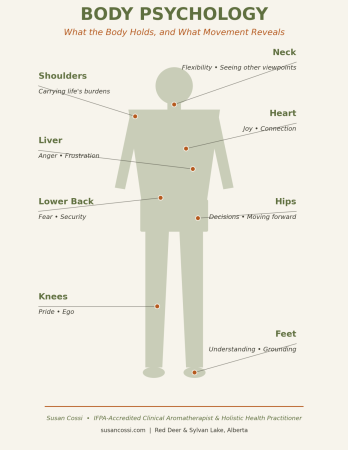
What the Body Holds, and What Movement Reveals
The body remembers what the mind sometimes will not say out loud. Long before a person names what they are feeling, it often shows up somewhere else first — a held breath, a locked knee, a shoulder pulled up toward the ear. As a metaphysician, this is the language I have spent 25 years learning to read: not just what a body says, but how it moves, holds itself, and guards its edges.
This article brings together two long-standing metaphysical traditions that map emotion onto the physical body: the Five Element theory from Traditional Chinese Medicine, which links each organ system to a core emotion, and the body-mind correspondences popularized by metaphysical teacher Louise Hay, which extend that mapping into posture, joints, and movement. Neither is a clinical diagnostic tool, and neither replaces medical care — but for those of us trained to observe the body as a whole, they offer a remarkably consistent vocabulary for what we witness every day in practice.
The Organs as Emotional Archives
In Five Element theory, each of the body’s major organ systems is paired with an element, a season, and a core emotion. When that emotion is suppressed, denied, or held for too long, the corresponding organ is believed to carry the strain.
Liver & Anger
The liver governs the smooth flow of qi throughout the body. Held or repressed anger is said to cause that flow to stagnate — showing up as tension headaches, a tight jaw, irritability, or a short fuse that seems to arrive faster than the situation warrants. A liver in balance, by contrast, is associated with patience and an even temperament.
Kidneys & Fear
The kidneys are considered the seat of willpower and deep reserves. Chronic fear or insecurity is thought to deplete this reserve over time, often surfacing as low back pain, knee weakness, or a generalized sense of being unsteady in one’s footing — quite literally.
Lungs & Grief
Grief and sadness are linked to the lungs. Unprocessed grief often shows up as a caved-in chest, shallow breathing, or a posture that seems to be protecting the heart from the front.
| Element | Organs | Linked Emotion | Common Physical Signs |
| Wood | Liver / Gallbladder | Anger, frustration, resentment | Headaches, tight jaw, menstrual irregularity |
| Fire | Heart / Small Intestine | Joy (in excess: anxiety, agitation) | Insomnia, restlessness, racing heart |
| Earth | Spleen / Stomach | Worry, overthinking | Digestive upset, fatigue, muscle heaviness |
| Metal | Lungs / Large Intestine | Grief, sadness | Shallow breathing, slumped chest, constipation |
| Water | Kidneys / Bladder | Fear, insecurity | Low back pain, knee weakness, low willpower |
Reading the Body in Motion
Movement is where these patterns become visible before a word is spoken. A person carrying unprocessed grief may walk with a collapsed chest. Someone gripped by fear may take short, hesitant steps, avoiding full weight transfer through the hips. Anger, when suppressed rather than released, often shows up as a jaw that never quite unclenches, or a stride that lands harder than it needs to.
Louise Hay’s body-mind correspondences extend this same logic to the joints and larger structures of the body, and they map closely onto what I observe in clients during consultations and workshops.
| Body Area | Metaphysical Association | What to Observe in Movement |
| Neck | Flexibility, willingness to see other viewpoints | Stiffness, tension, stubbornness in posture |
| Shoulders | Capacity to carry life’s burdens | Rounded, raised, or braced shoulders |
| Upper Back | Grief, feeling unsupported emotionally | Hunching, collapsed chest |
| Lower Back | Fear around finances or security | Guarding, reduced range of motion |
| Hips | Moving forward, decision-making | Restricted stride, hesitant gait |
| Knees | Pride, ego, ability to yield | Locked knees, stiff or resistant walk |
| Feet | Understanding of self, life, and others; connection to the earth | Heavy or shuffling step, favouring one foot, reluctance to bear full weight |
Feet deserve special attention in this list. As our point of contact with the ground, they are often the last place people think to look — yet a heavy step, a shuffle, or a habit of favouring one foot can say as much about a person’s relationship to moving forward as any other part of the body. This is also where reflexology becomes such a valuable diagnostic companion to metaphysical observation: the feet map the entire body, and tension held there often mirrors tension held everywhere else.
Why This Matters in Practice
None of this is meant to replace a proper medical work-up — persistent pain or illness always deserves clinical attention first. But metaphysical body mapping offers something medicine alone often doesn’t: a way to ask what a symptom might be inviting a person to look at, alongside the physical treatment plan. A stiff neck may need a pillow adjustment and a massage — and it may also be worth asking what viewpoint the person has been unwilling to turn toward lately.
In my own sessions, I watch how someone enters a room before they say a word: whether their shoulders lead or trail, whether their stride is full or clipped, whether their hips rotate freely or seem locked in place. These small physical tells often open the door to the deeper conversation faster than direct questions do.
Bringing Awareness Into Your Own Body
- Notice which body part you protect or brace first when you feel stressed
- Ask what emotion you may be storing rather than expressing, and where you feel it physically
- Pay attention to recurring physical complaints — is there a pattern in when they arise?
- Pair somatic awareness with grounding practices: breathwork, essential oils, or gentle movement like a supported squat to release through the hips and low back
- Work with a practitioner who can hold both the physical and energetic picture at once
| A note on framing: these are metaphysical and traditional frameworks passed down through centuries of observation, not peer-reviewed medical claims. They are offered here as a lens for self-reflection and practitioner insight, not a diagnosis. |
Susan Cossi is an IFPA-Accredited Clinical Aromatherapist and Holistic Health Practitioner with over 35 years of experience, bridging Eastern and Western healing traditions through Holistic Teachings Inc. in Red Deer and Sylvan Lake, Alberta. Visit susancossi.com to book a consultation.