Understanding Wood, Fire, Earth, Metal & Water — and How to Support Each One
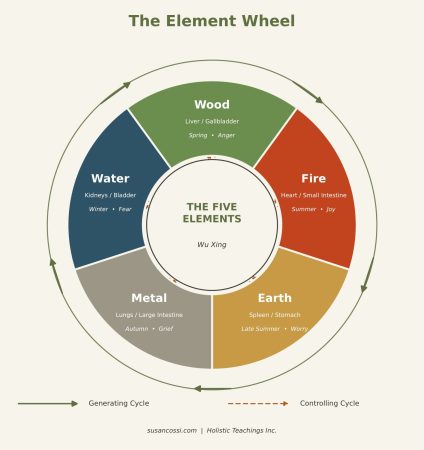
In my last article, I introduced the Five Element framework from Traditional Chinese Medicine — the idea that each of our major organ systems is paired with an element, a season, and an emotion, and that when that emotion is held too long, the corresponding organ carries the strain. Several of you asked the natural next question: okay, so what do I actually do about it? This article is that answer — element by element, with the foods, herbs, and activities traditionally used to bring each one back into balance.
Take Metal, for example, since it’s the one people ask about most. Metal governs the lungs and large intestine, and it’s tied to the emotion of grief. When grief goes unprocessed — a loss that was never fully mourned, a change that was never fully accepted — Metal is believed to weaken, and that often shows up physically as shallow breathing, a chronic cough, skin dryness, or sluggish elimination. It also tends to surface seasonally: autumn is Metal’s season, the time of letting go, and many people notice their mood or breathing shift as the leaves fall. The traditional response isn’t complicated — pungent foods like onion, garlic, and radish to move stagnant qi through the lungs, herbs like licorice root to moisten and soothe, and practices like deep breathing or a decluttering ritual to support the letting-go this element governs.
That same logic — element, organ, emotion, and then food, herb, and activity to restore balance — applies across all five. Here’s the full picture.
The Five Elements at a Glance
| Element | Organs | Season | Supportive Foods | Traditional Herbs | Balancing Activities |
| Wood | Liver / Gallbladder | Spring | Leafy greens, sour foods (lemon, sauerkraut) | Milk thistle, dandelion root, bupleurum | Tai Chi, qigong, stretching, time in nature |
| Fire | Heart / Small Intestine | Summer | Bitter foods (romaine, asparagus, dark chocolate), cooling foods | Chamomile, valerian | Social connection, joyful movement, calming rituals before bed |
| Earth | Spleen / Stomach | Late Summer | Warm, cooked foods — soups, stews, sweet potatoes, squash | Ginseng, codonopsis, astragalus | Grounding practices, regular mealtimes, gentle walks after eating |
| Metal | Lungs / Large Intestine | Autumn | Pears, white foods, pungent foods (onion, garlic, radish) | Licorice root, astragalus, platycodon | Deep breathing, decluttering, journaling, letting-go rituals |
| Water | Kidneys / Bladder | Winter | Black foods (black beans, black sesame, seaweed), bone broth | Rehmannia, goji berry, eucommia bark | Rest, meditation, gentle restorative movement, early bedtime |
Wood — Spring, Liver & Gallbladder
Wood governs the smooth, upward flow of qi, much like sap rising in a tree each spring. When Wood is balanced, it shows up as clear decision-making and steady motivation. When it’s constrained, the classic sign is anger or frustration that arrives faster than the situation calls for.
Sour foods and leafy greens are traditionally used to nourish the liver, while herbs like milk thistle and dandelion root support its detoxifying role. Movement matters here more than almost any other element — Wood wants motion. Tai Chi, qigong, stretching, and simply spending time outdoors all help keep this element’s energy flowing rather than stuck.
Fire — Summer, Heart & Small Intestine
Fire is the element of joy, connection, and circulation. In balance, it brings warmth and enthusiasm; out of balance, it tends to show up as anxiety, insomnia, or a restless heart that won’t settle.
Bitter foods — romaine, asparagus, a little dark chocolate — are traditionally considered cooling for an overheated Fire element, alongside calming herbs like chamomile and valerian. Because Fire is so tied to connection, joyful social activity is itself a balancing practice, paired with a calming wind-down ritual before bed to protect sleep.
Earth — Late Summer, Spleen & Stomach
Earth governs digestion and our ability to take in and process nourishment — both literal and emotional. When Earth is out of balance, worry and overthinking tend to dominate, often alongside digestive upset or fatigue.
Warm, cooked foods are the traditional foundation here — soups, stews, sweet potatoes, squash — since Earth responds well to nourishment that’s easy to digest. Herbs like ginseng, codonopsis, and astragalus are traditionally used as spleen tonics. Regular mealtimes and grounding practices, like a short walk after eating, help settle this element.
Metal — Autumn, Lungs & Large Intestine
As introduced above, Metal governs the lungs and large intestine and is tied to grief and the ability to let go. Pungent, slightly warming foods — onion, garlic, ginger, radish — help keep qi moving through the lungs, while pears and other moistening foods counter the dryness Metal is prone to in autumn.
Traditional herbs like licorice root and platycodon are used to soothe and open the lungs. Because this element governs release, practices like deep breathing, decluttering, and journaling through what needs to be let go of are considered just as important as diet.
Water — Winter, Kidneys & Bladder
Water holds the body’s deepest reserves — what TCM calls essence, the foundation we’re born with and draw on throughout life. Fear and insecurity are Water’s associated emotions, and when this element is depleted, it often shows up as low back pain, knee weakness, or a generalized sense of being unsteady.
Black foods — black beans, black sesame, seaweed — and warming foods like bone broth are traditionally used to nourish the kidneys, alongside herbs like rehmannia, goji berry, and eucommia bark. Because Water governs rest and restoration, this is the element most supported simply by slowing down: earlier bedtimes, meditation, and gentle, restorative movement rather than intense exertion.
| A note on framing: Five Element theory is a traditional framework with a long clinical history in Chinese medicine, but it is not a substitute for medical diagnosis or treatment. Herbs listed here can interact with medications and are not appropriate for everyone — please consult a qualified TCM practitioner or your healthcare provider before adding any new herb to your routine, especially if you are pregnant, nursing, or managing an existing health condition. |
Bringing It Into Daily Life
- Notice which element’s emotion shows up most for you — anger, joy, worry, grief, or fear — and start there
- Eat with the season: warming and grounding in autumn and winter, light and green in spring, cooling in summer
- Introduce one herb at a time, and always with proper guidance, so you can track how your body responds
- Pair diet with the matching activity — movement for Wood, connection for Fire, grounding for Earth, breathwork for Metal, and rest for Water
- Revisit the organ-emotion chart from my last article alongside this one — the two are meant to be read together
Susan Cossi is an IFPA-Accredited Clinical Aromatherapist and Holistic Health Practitioner with over 25 years of experience, bridging Eastern and Western healing traditions through Holistic Teachings Inc. in Red Deer and Sylvan Lake, Alberta. Visit susancossi.com to book a consultation.